The Fractured City
A design installation by 123 West Design Collective
The 2026 Seattle Design Festival theme, IN[FLUX], recognizes that we are living in a moment of transition. Flux suggests movement, instability, and possibility all at once. It reflects the ways our city is evolving and the role design can play in navigating change. This year's theme invites designers, artists, community members, and thinkers to explore four lenses within this shared framework:
-
IN[FLUX] How can design respond to constant change and uncertainty?
-
IN[HABIT] How do our routines, behaviors, and systems shape the way we live?
-
IN[FORM] How do ideas take physical shape through design, materials, and space?
-
IN[TENSION] How can design engage conflict, difference, and competing priorities?
Together, these lenses explore the forces that shape our city: movement and stability, structure and experimentation, agreement and disagreement. Through installations, conversations, and experiences across Seattle, the Festival invites our community to examine how design operates within these conditions and how it can help us imagine what comes next.
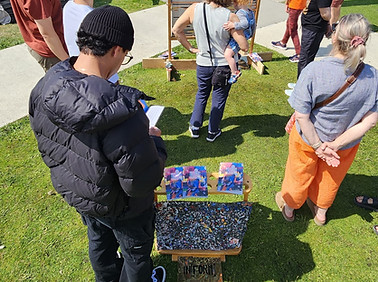
The Fractured City is an interactive public art experience that invites festival-goers to explore how cities evolve through design choices, social dynamics, environmental pressures, and community influence. Featuring a series of large-scale, hands-on fabric installations, visitors can rotate, swap, clip, and rearrange painted textile elements to transform evolving cityscapes throughout the day.
One installation reveals contrasting visions of a city in disarray and harmony through rotating fabric panels, while another allows participants to build entirely new neighborhoods by repositioning painted fabric strips along tensioned chains. The Fractured City transforms festival-goers from observers into active participants in reimagining the future of the urban environment.

01
IN[FLUX]
This watercolored sketch by Mary B. Truly showcases the main built components of a city. Unclip / reclip the different panels until you feel like they are in the correct order for an effective city. Why did you place them in this order? What can be learnt by urban planners to make better community decisions?
02
IN[HABIT]
Add colored tape to the frame. Choose and place each color based on it's relationship to how to spend your time - resting, playing, working alone, working with friends, etc. As more people add their tape, an infographic will emerge to help designers plan spaces for time. How does understanding a community's rituals and habits inform a public space?


03
IN[TENSION]
Pull and rotate the ribbons to change how your city appears. Think about the cause and effect that urban planning has on our public spaces. Do you feel hopeless when it comes to changing your community or is it as easy as pulling on the right ribbon? How can you improve your own city?
04
IN[FORM]
Pick up a zine and read it! If you don't have a zine, click HERE. Congratulations, you did it! If this is your first introduction into the Future of Art and Design, welcome! We pride ourselves on creating content that is helpful and fun. Come visit us in Port Angeles sometime.